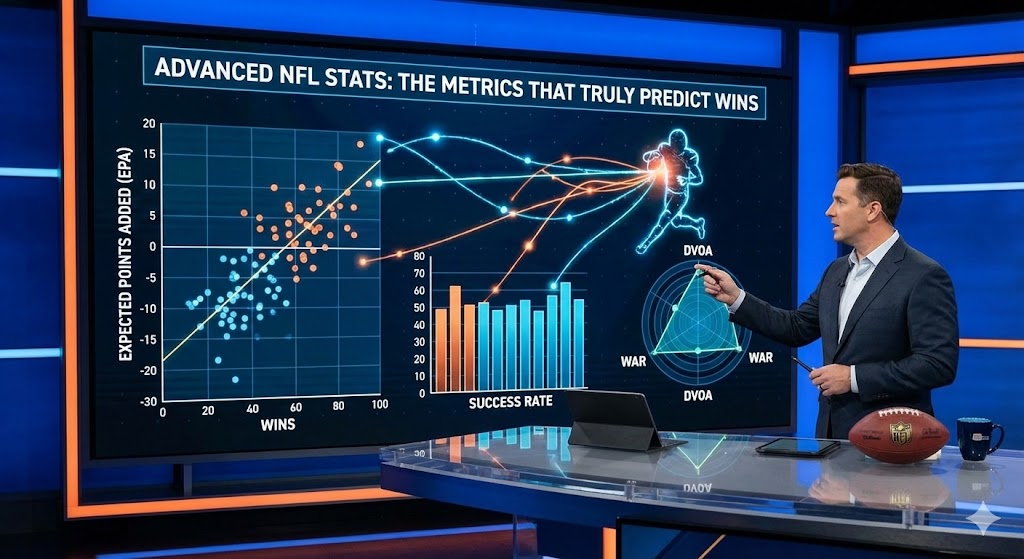
Advanced NFL Stats: The Metrics That Truly Predict Wins
Advanced NFL stats offer a clearer, smarter way to understand which teams are truly built to win. Traditional numbers like yards, points, and simple rankings help, but they don’t tell the full story.
Modern analytics reveal the deeper metrics that predict long-term success, expose hidden weaknesses, and explain why some teams consistently outperform expectations.
This guide breaks down the advanced NFL metrics that matter most — the ones that reliably predict wins week after week.
1. EPA per Play: The Most Telling Efficiency Metric
Expected Points Added (EPA) per play is one of the strongest indicators of team success. It measures how each play impacts a team’s expected scoring outcome.
Why EPA predicts wins:
- Shows true offensive efficiency
- Adjusts for down, distance, and field position
- Highlights consistent playmakers
- Reveals which teams maximize every possession
Teams with high EPA per play usually finish among the league’s best offenses.
2. Success Rate: Consistency Over Explosiveness
Success rate measures how often a play stays “on schedule” — gaining enough yards to maintain momentum.
Why success rate matters:
- Indicates steady, sustainable drives
- Shows whether a team avoids negative plays
- Predicts third-down outcomes
- Reflects strong game planning
Teams with high success rates tend to control tempo and wear down defenses.
3. Pressure Rate: Defense That Disrupts Wins Games
Pressure rate shows how often a defense forces hurried throws, hits the quarterback, or collapses the pocket.
Why pressure rate predicts victory:
- Leads to turnovers
- Reduces big-play opportunities
- Impacts quarterback rhythm
- Forces bad decisions
Defenses that create consistent pressure often outperform their talent level.
4. Turnover Worthiness: A Smarter Look at Ball Security
Instead of just looking at turnovers, advanced stats track turnover-worthy plays — throws or runs that should have resulted in a turnover.
Why this metric matters:
- Predicts future turnovers with high accuracy
- Shows quarterback decision quality
- Helps measure true offensive risk
Teams with low turnover-worthy plays usually win more close games.
5. Explosive Play Differential: Big Plays Change Everything
Explosive plays are runs or passes that gain 20+ yards. Differential compares explosive plays created vs. allowed.
Why explosive plays predict wins:
- Create instant scoring opportunities
- Shift momentum
- Flip field position
- Expose mismatches
Teams with a positive explosive differential often control game flow.
6. Red Zone Efficiency: Where Games Are Won
Advanced red zone efficiency goes beyond touchdowns and includes play sequencing, matchup usage, and defensive red zone stops.
Why red zone metrics matter:
- Predict late-game success
- Reflect coaching quality
- Show situational discipline
- Turn field goals into touchdowns
Strong red zone performance is one of the most reliable win predictors.
7. Early-Down Efficiency: Setting Up Easy Third Downs
Teams that perform well on first and second down rarely face difficult third downs.
Why early-down metrics matter:
- Lead to shorter conversions
- Prevent negative game script
- Allow balanced play-calling
- Keep defenses guessing
Strong early-down teams often dominate time of possession.
8. Coverage Grades: The Hidden Key to Stopping Elite Offenses
Coverage performance is one of the most powerful defensive predictors of wins.
Why coverage grades matter:
- Limit explosive passes
- Reduce yards after catch
- Force quarterbacks into tight windows
- Increase interception chances
Teams with strong coverage often outperform teams with strong pass rush alone.
9. Run-Stop Win Rate: The Foundation of Defensive Stability
Run-stop win rate measures how often defenders successfully stop runs at or near the line of scrimmage.
Why run-stop win rate predicts wins:
- Forces obvious passing situations
- Gives defenses more blitz options
- Helps control game script
- Prevents sustained opponent drives
Strong run defenses help teams maintain leads late in games.
10. Special Teams Efficiency: The Overlooked Predictor
Advanced special teams analytics track:
- Expected points on punts and kicks
- Return lane efficiency
- Field-position shifts
- Block probability
Why special teams matter:
- Impact hidden yardage
- Set up scoring drives
- Prevent momentum swings
- Decide close games
Small edges here often turn into major wins.
Conclusion
The most important advanced NFL stats go far beyond traditional box scores. Metrics like EPA per play, success rate, pressure rate, explosive play differential, and red zone efficiency offer a deeper, more accurate picture of team performance.
Teams that excel in these areas consistently win — even when public perception doesn’t match the analytics. For fans, understanding these metrics provides a smarter way to follow the season and evaluate every matchup with confidence.